
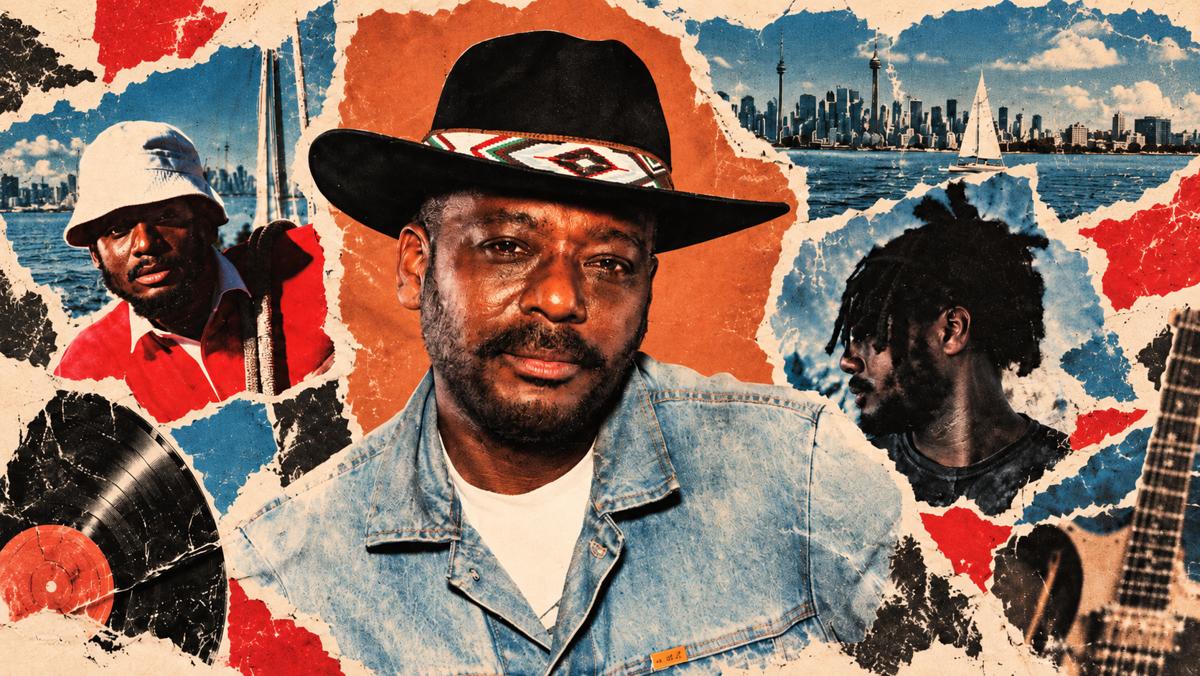
In 2002, k-os released an album called Exit. He wasn't being cryptic. Kevin Brereton had grown so frustrated with the music industry that he intended the record to mark the end of his recording career.
He had already spent years navigating failed deals, uncomfortable expectations and the difficulty of finding somewhere to belong in Canadian hip-hop. His debut finally gave him a proper platform, but he wasn't convinced the business was worth the trouble.
In a 2024 interview with Exclaim!, Brereton recalled how reading a book changed his perspective. Looking at its publishing information, he realized that even the work of an author he admired had to pass through a commercial system to reach its audience. The problem wasn't necessarily participating in the industry. It was allowing the industry to determine what he created.
Two years after Exit, he released Joyful Rebellion, a record that turned his frustration into platinum sales, major radio hits and three wins at the 2005 JUNO Awards.
But the story of how k-os arrived there goes back much further than “Crabbuckit.”
Long before Toronto's later global hip-hop breakthrough, Brereton was trying to establish himself in a scene with limited opportunities for national exposure. He had spent part of his childhood in Trinidad before returning to Canada, eventually developing his musical identity around Toronto and Whitby.
His influences didn't fit neatly into one category. He grew up singing, absorbed the positive, jazz-informed approach of A Tribe Called Quest and the Native Tongues collective, and found himself drawn to the expressive possibilities of rapping.
As he explained to Del F. Cowie in an early career interview published by Exclaim!, he initially sang hooks for friends who rhymed in ciphers before being encouraged to rap himself. Hearing Q-Tip experiment with singing on A Tribe Called Quest's The Low End Theory helped him recognize that his two interests could coexist.
That combination of singing and MCing became central to his identity, but it also complicated his relationship with the local scene.
His early single “Musical Essence” received significant exposure on MuchMusic in the mid-1990s, introducing audiences to a young rapper whose approach was melodic, reflective and considerably different from the harder-edged sounds gaining prominence elsewhere.
The attention led to an invitation to join the 1995 Hip-Hop Explosion tour alongside Canadian acts including Rascalz and Ghetto Concept. At the Toronto stop, however, some audience members challenged his credibility.
In Cowie's interview, Brereton recalled how an earlier article discussing where he lived had prompted questions about his connection to particular Toronto neighbourhoods. He felt that his optimistic music, combined with perceptions about his background, had made him a target. The confrontation escalated when people rushed the stage.
The experience forced him to reconsider whether his approach adequately reflected the people he was trying to reach. He began questioning whether his musical idealism had left him disconnected from some of hip-hop's harder realities.
It would have been easy to respond by adopting a harder persona. Instead, he continued figuring out how to make his influences coexist.
He collaborated with Toronto producers Da Grassroots, worked with members of the Rascalz and spent time away from the industry's machinery. His eventual return involved acoustic guitars, live instrumentation and a growing confidence that Canadian hip-hop didn't need to reproduce an American template to establish its legitimacy.
By the time Exit finally arrived in 2002, k-os was already making music that treated hip-hop as a foundation rather than a set of restrictions.
“Heaven Only Knows” placed philosophical questions inside an accessible rap record. “Superstarr” explored reggae and rock influences, while “Freeze” confronted the commercialization of hip-hop through the example of one of his own inspirations, Q-Tip.
Brereton told Cowie that watching Q-Tip's “Vivrant Thing” video had helped inspire “Freeze.” The song borrowed lines from A Tribe Called Quest records to question what he saw as a troubling shift in hip-hop's priorities. His criticism wasn't simply directed at Q-Tip. It reflected a broader frustration with the music's commercial direction.
The record was ambitious, but its creator was exhausted.
Then came Joyful Rebellion.
Released on Aug. 13, 2004, the album was less a rejection of everything that came before than a change in how Brereton approached it. Rather than asking his music to correct the industry, he allowed himself to enjoy making records within it.
The result was remarkably varied. “EMCEE Murdah” challenged rappers sacrificing creativity for commercial rewards, while “Crucial” explored reggae rhythms and “Commandante” incorporated flamenco influences. “Man I Used to Be” moved into melodic pop territory, complete with the kind of chorus that could reach listeners who might never have bought a conventional rap album.
And then there was “Crabbuckit.”
Built around acoustic guitar, a bouncing rhythm and an instantly memorable hook, the song approached ambition and resentment through the familiar image of crabs pulling one another down inside a bucket. Its message was pointed, but its presentation was playful.
In his 2024 Exclaim! conversation, Brereton recalled coming up with the song's guitar idea in roughly five minutes, using the top string of the instrument. One of his most successful records had emerged from a moment of simplicity rather than a carefully engineered attempt at a crossover hit.
The song helped introduce k-os to an audience far larger than the Canadian hip-hop underground. At the 2005 JUNO Awards, Joyful Rebellion won Rap Recording of the Year, while “Crabbuckit” won Single of the Year and “B-Boy Stance” won Video of the Year.
These weren't small achievements for a Canadian rapper working across genres at a time when the domestic industry offered relatively few comparable success stories.
Yet the acclaim also created another problem. Once k-os established that his experimental approach could produce hits, there was an expectation that he might keep doing it.
Instead, he continued changing.
Atlantis: Hymns for Disco arrived in October 2006, pushing further into pop and alternative rock. “Sunday Morning” became another substantial success, while contributions from musicians including Sam Roberts, Kevin Drew and Sebastien Grainger reflected the increasingly porous boundaries between his work and Canada's independent rock community.
The album went platinum in Canada, demonstrating that Joyful Rebellion hadn't been a one-off commercial breakthrough.
But popularity didn't entirely resolve the questions that had followed him since the 1990s.
In a 2015 interview with Vice, Brereton reflected on his earlier ambition to change the world through music. By the time of Atlantis, he had begun to recognize the limits of that expectation and reconsider what he wanted his work to accomplish.
His subsequent albums reflected that evolving perspective, sometimes to mixed commercial results.
Yes! arrived in 2009, followed by the ambitious double album BLack on BLonde in January 2013. The latter divided his interests into separate rap and rock discs, effectively giving two sides of his musical personality their own space.
It was an unusual decision for someone who had built a reputation on combining styles. But the division also acknowledged a tension that had persisted throughout his career.
In a 2013 Exclaim! interview, Brereton discussed how his concern about satisfying hip-hop listeners had sometimes shaped the production and selection of songs. He acknowledged that the hip-hop purist he was trying to satisfy was partly himself. Separating the music gave him permission to explore both directions without forcing them to meet in the middle.
He also challenged the assumption that making pop music meant sacrificing credibility. His argument was straightforward: an artist could pursue mainstream accessibility and serious lyricism without treating either as a betrayal.
That position helped define the peculiar space k-os occupied in Canadian music. He was never simply a rapper who occasionally sang, nor a pop performer borrowing elements of hip-hop. He had legitimate connections to Toronto's rap community while collaborating freely with artists outside it.
On 2015's Can't Fly Without Gravity, the posse cut “Boyz II Men” brought together Saukrates, Kardinal Offishall, Choclair, King Reign and Shad. The lineup connected multiple generations of Canadian MCs on a record from an artist who had spent much of his career resisting easy categorization.
There is something revealing about that combination. Even as his music moved outward into other genres, his relationship with Canadian hip-hop remained central to the work.
The same can be said of his relationship with Drake.
Long before Drake became Toronto's most commercially successful rapper, he was an admirer of k-os. Their connection eventually produced “Faith,” which appeared on The Anchorman Mixtape in 2010. A follow-up, “Faith Pt. 2,” arrived in 2011, again featuring Drake.
The relationship has taken on renewed significance in 2026.
On Oct. 2, k-os released “Guns&Roses” and announced plans for his first full-length album since Can't Fly Without Gravity. Complex reported, citing k-os's Instagram announcement, that Drake is financing the project, with DreamCrew executive Matte Babel handling management. Neither Drake nor DreamCrew had independently confirmed the financing in the reporting cited.
This isn't the first indication that the two were planning a new record. In 2024, an Exclaim! report accompanying the Atlantis+ reissue teased an album titled Everyone in Your Dream Is You, described at the time as executive-produced by Drake. That proposed release never materialized on its original timeline, and the current album's title, tracklist and release date remain unconfirmed.
Still, the relationship adds an interesting dimension to k-os's return.
Drake built an enormously successful career in a hip-hop landscape where melody, vulnerability, singing and rapping could coexist. k-os had been exploring some of those possibilities years earlier, often while negotiating whether they were acceptable to the audiences around him.
That doesn't make their careers interchangeable, nor does it mean Drake's success can be traced to one predecessor. Toronto's hip-hop history is much bigger than either artist.
But it does offer a reminder that the city's later international success emerged from a musical culture already experimenting with its own identity.
For k-os, that experimentation was never a straight line. He has embraced and rejected expectations, questioned the industry while succeeding within it, and repeatedly reconsidered what his music should accomplish.
His career contains platinum albums and commercial disappointments, moments of fierce conviction and equally important moments of self-doubt.
Perhaps the most interesting thing about his forthcoming record isn't whether it can reproduce the success of Joyful Rebellion. That album succeeded precisely because Brereton had stopped trying to follow someone else's instructions.
More than three decades after “Musical Essence” first reached MuchMusic viewers, the question remains much the same: What happens when k-os decides to make music entirely on his own terms?